
Could Mumbai have been saved from terror on November 26, 2008? Perhaps, had the intelligence agencies of India, United States and Britain worked together.

Condemning terrorism in all its forms and manifestations, US President Barack Obama and Pakistan Prime Minister Nawaz Sharif on Thursday said that no country's territory should be used to destabilise its neighbours.

'The Pakistanis were lulled adequately to provide one of the fundamental prerequisites for successful execution of such an option: Surprise.' 'The other requisite: Deception in terms of selection of areas for launch/time of offensive action,' explains Brigadier S K Chatterji (retd).

'For a long time Pakistan dreamt that India would break up and that it would be the predominant power in the region,' says Colonel Anil A Athale (retd).

After weighing all the costs and benefits, the next administration is likely to reduce and restructure assistance to Pakistan but not to end it altogether, says Daniel S Markey.

'Bhutto feared elements of the so-called establishment, including people linked to the intelligence services. She highly distrusted individuals like Hamid Gul who -- she was convinced -- maintained active ties with jihadists.' Heraldo Munoz, author of the sensational new book, Getting Away With Murder, tells Rediff.com's Vicky Nanjappa in an exclusive interview.

The start of Indian lobbying in the US can be traced back to Pakistan's anti-India lobbying. Policy wonk Ashok Sharma documents this journey and its catalytic role in transforming the US-India relationship.
.jpg)
Beating of war drums, would further accord primacy to the army in Pakistan. A better approach would be to continue the talks for normalisation of trade relations, while giving the Indian forces autonomy to strike at militant camps across the LoC, says Alok Bansal

'Pakistan is full of 'religious entrepreneurs' like Hafeez Saeed who poison the minds of the young so that they can be motivated to become terrorists. They work in concert with the rulers of Pakistan. It is a private-public partnership.'

'The civil war in Islam has just got worse and the existential crisis facing it more threatening.'

Here's a look at the 10 most dangerous countries in the world.

'Europe can be discussed on a golf course...' 'North Korea? What do I care what the man with the bad haircut does?'

The recent breach of ceasefire by Pakistan was aimed at infiltrating Lashkar-e-Tayiba cadres into Jammu and Kashmir ahead of the polls and to bring Kashmir issue back into limelight, as the neighbouring country was feeling isolated with the growing clout of India in the international forum, according to security experts.

Council on Foreign Relations Senior Fellow Daniel Markey Tuesday said that the raising of the issue of American intervention in Jammu and Kashmir by visiting Pakistani Prime Minister Nawaz Sharif at the United States Institute of Peace in Washington was not 'especially constructive' and was motivated by political expediency.

The US #DeepState has had a fine run, but will now discard Saudi Arabia as it is no longer useful to them, says Rajeev Srinivasan.

The Geneva agreement is a signal, which at least Saudi Arabia and Israel are so reading, that normalisation of relations between US and Iran is not merely about the nuclear fuel cycle, says K C Singh.
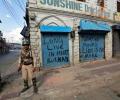
Separatists and their wide network must be neutralized for peace in the Valley

The year 2014 is coming to an end. It was the year of conflict, the year of strife. Year 2014 will be remembered for several reasons -- the rise and threat of the Islamic State, the downing of two Malayasia Airlines aircraft and the sudden and effective way of using hastags on social media to generate a buzz about the event. After all, who can forget #theicebucket challenge and the phenomenon it grew into. Read on as we bring you an overview of international news and events of 2014.

'If there's one administration that would be likely to put the squeeze on Pakistan, it's the Trump administration.' 'This is an administration that views terrorists as a black and white issue (kill them all, no questions asked), and will have little patience for Pakistan's selective policy toward terrorism.'
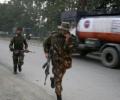
'No amount of economic measures or prosperity in Kashmir will make any dent in the situation there. The average Kashmiri understands the Pakistani game and is unlikely to prefer Pakistan over India. But the Pakistanis have made clever use of religious symbols and slogans to force religious-minded Kashmiris to support them. India has failed to counter this posturing by the separatists,' says Colonel Anil A Athale (retd).

'Devyani -- she is a public servant and her personal life has already received far too much attention -- and her ambitious father now need to retreat to the background so that wiser diplomatic heads restore sanity to India-US relations as India prepares for parliamentary elections,' says Ambassador K C Singh.

'The creation of Pakistan was integral to Britain's grand strategy.' 'If they were to ever leave India, Britain's military planners had made it clear that they needed to retain a foothold in the NWFP and Baluchistan because that would provide the means to retain control of Iran, Iraq, Kuwait, the UAE, Bahrain and Qatar.'

'It is in the interest of both sides that the visit of the US President is seen as being successful. Both sides have invested considerable political capital in it. This rapid exchange of visits and the decisions taken have to be justified, beyond the symbolism, which is no doubt important in itself. This opportunity to impart a fresh momentum to ties should not be missed,' says former foreign secretary Kanwal Sibal.
